Drunk driving prevention is difficult, but we already know how to do it

Out of roughly 34,000 traffic-related fatalities in 2009, about one-third involved a driver with a blood-alcohol content of 0.08 or above (the minimum for a DUI offense in every state). Thinking about this I wondered whether this number could be reduced by increasing the penalties for higher BAC levels, since the chances of a collision rise quickly as impairment increases, but fines, suspensions, and jail time do not. After doing some research on the subject, I found instead that this is actually a very complicated issue (surprise!), and my intuition didn't really stand up to scrutiny. Case in point was Wisconsin, a state that already has penalties that scale with BAC but in both 2008 and 2009 had significantly higher rates of alcohol-related fatalities than the national average. Something else is going on here.

Just so you can get a sense for the argument I was making originally, here's the bulk of what I'd written before deciding to add the above disclaimer and what comes afterward:

Idea: drunk driving penalties should be more closely tied to blood-alcohol content

The penalties for a DUI conviction usually include a small amount of jail time, a 30-day to one-year driver's license suspension, and a few hundred to a few thousand dollars in fines--most states also have enhanced penalties which kick in BAC levels of 0.15-0.20. In the case of Washington state, though, the increased penalties for BAC at or above 0.15 don't have much bite: the same maximums for jail time and fines, with barely increased minimums, and a longer license suspension, one year instead of 30 days. Drunk driving of any kind is a serious crime that threatens the lives of the driver, passengers, and anyone else on the streets or sidewalks, but there's a big difference between driving with a 0.08 and a 0.15 BAC. We need to formally recognize this reality, and ensure that the penalty is commensurate with that increased risk.

According to this study by the National Highway Traffic Safety Administration, the risk of a crash is 1.74-2.69 times higher at a BAC of 0.08. At 0.15, crash risk is increased by 8 to 22 times, and at 0.20 the risk is 21 to 82 times higher relative to driving unimpaired. (The ranges represent the difference between the study's observed crash rates and its adjustment for those who refused to participate, were involved in hit-and-runs, etc., so the higher number is theoretically the more accurate risk estimate.) So in Washington, even though you're about 30 times more likely to get into a wreck at a BAC of 0.20 compared to 0.08, the punishment hardly differs at all. In the eyes of the law, the severity of each crime is essentially the same. Below is a graph from the study, illustrating the exponential increase in crash risk as BAC increases:
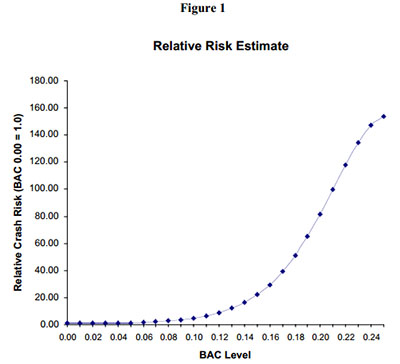
Crash risk vs. BAC, from NHTSA.

Crash risk vs. BAC, from NHTSA.

DUI laws in Washington (and many other states, I'm sure) aren't very sensible, but we can look elsewhere for guidance toward a better system. Although I think it still underrates the seriousness of BAC levels much higher than 0.08, Wisconsin has a system that's definitely superior to Washington's. There, penalties double, triple, and finally quadruple as BAC increases. A driver with a >0.25 blood-alcohol content faces penalties four times greater than someone arrested for DUI with a BAC between 0.08 and 0.149, and this includes fines, jail time, and license suspension. Of course, we can see from the above graph that a person with a BAC of 0.25 has a 160-times higher risk of getting into a collision compared to a sober person, and fifty times the risk of a person with a BAC of 0.08, so penalties that are only four times worse (at most) don't really capture the seriousness of driving with a very high BAC.

If BAC-scaled penalties aren't the solution, what is?

Based on the data from Wisconsin, increasing penalties for more serious drunk-driving infractions is not the whole solution. That doesn't mean it can't be a part of it, but it's not enough by itself. So what else can we do? My next thought was that perhaps part of the problem is that, at least in Washington, we so rarely actually convict people of DUIs. I have several friends who have been arrested for DUIs, and all of them were able to plead down to a "wet reckless" with the help of a lawyer, a much less serious crime, even though they blew over a 0.08 on the breathalyzer. Maybe the problem isn't that DUI penalties are insufficient, but that so few people are actually convicted of the crime they've committed.

Nope. Texas doesn't allow defendants to have their charge reduced to a wet reckless, and yet they had even higher rates of alcohol-related fatalities than Wisconsin did. Again though, things aren't so simple: Texas has extremely lax penalties even for a DUI conviction, with no minimum for fines, and as little as 3 days in jail and a 90-day license suspension.

Like I said, this turned out to be pretty complicated (again--surprise!). The most effective solution I found was actually a program that started in Washington state itself in November 2006, and was followed up in 2010. The study was performed in the three biggest counties in Washington and consisted of adding six--yes, just six--state patrol officers to each county, their primary goal being to crack down on alcohol and drug-impaired drivers. The report can be found at the NHTSA's web site [PDF]; it's only 5 pages and I encourage you to check it out for yourself. The gist of the report is captured by the following graph:

From National Highway Traffic Safety Administration.

From National Highway Traffic Safety Administration.

The TZTP counties are the three with the extra WSP officers. As you can see, compared to the average over the previous five years, the TZTP counties experienced a 34.4% decline in alcohol- and drug-related fatalities. That's in one year. Compare this to a 28.4% increase in the next two biggest counties (Clark and Spokane), and an 8.5% decline in the rest of the state. It's very possible that the numbers might jump up a bit after people get used to the presence of these extra patrols, but the difference between the pre- and post-TZTP eras is stark and worth investigating further. I have to reiterate once more that this is the result of adding just 18 officers (plus another ten or so support staff) to three counties with a total population of 3.5 million. We could do much more.

During the 10-month window of the study these officers made over 3,000 DUI arrests, 3,000 speeding citations, and 900 seat belt citations. In theory this should mean several million dollars in fines, more than enough to cover the expense of these extra patrols. Due to the leniency of our sentencing, however, I couldn't really guess what we're actually collecting as a result of these arrests. But more importantly than all that, the presence of these officers saved dozens of lives, possibly including the innocent drivers, bicyclists, and pedestrians these drunk drivers might have struck with their vehicles. The fact that it was at essentially zero cost to the state is just icing on the cake.

One way to ensure that we can capture that revenue and keep our drunk-driving patrols funded is to follow in Texas' footsteps (never thought I'd say that) and stop allowing offenders to plea down to wet reckless. Instead of punishing drunk drivers through the justice system's fines and suspensions, we're basically just redirecting that money to DUI lawyers--the people I know that were arrested for DUIs each paid about $5,000 through the whole process, but most of that money went to their lawyers. And for what? What do the lawyers contribute? No one is disputing the fact that these people were driving with a BAC at or above 0.08. The state should collect that money itself in the form of the DUI fines it rarely seems to collect, and use it to fund more patrols instead of enriching a few unnecessary lawyers.

I started this post planning to make a strong argument for increasing drunk-driving penalties, but after starting to write I realized there isn't evidence to back up my claims. Not without controls that don't yet exist, at least. And that's fine. Perhaps not surprisingly, I learned that enforcement seems to be the most effective way to prevent drunk driving and save peoples' lives. These two arguments intersect, however, at funding. If we want to be able to pay for extra patrols, the money needs to come from somewhere, and more strict penalties--or consistent sentencing, at least--could be part of the solution. And as we work to increase enforcement and seek to provide further evidence for its efficacy, let's keep finding new ways to prevent drunk driving, whether that means harsher penalties, more accessible alcohol and drug treatment programs, better transportation options, or all of the above. Even the most incremental improvement can mean hundreds of lives saved over the next few decades, and safer roads for everyone.

Infrastructure stimulus is different

The theory behind stimulus spending is that when private spending and investment fall short of expectations, government can step in and make up the difference. Things like temporary payroll tax cuts, extending unemployment benefits, and grants for states to keep teachers in schools are great examples of ways the federal government can assist individuals, businesses, and cities, but they differ from infrastructure spending in a key way: while most stimulus measures are only needed as a response to recessions and shortfalls in consumer demand, investing in infrastructure and maintenance is something we need to do--but haven't--in booms as well as busts. What they share, however, is that recessions (and their recoveries) are always the best time to make these expenditures.

Why is this the best time to spend on infrastructure? Contracting is very cheap right now since construction companies are so desperate for business. Borrowing costs for the federal government are so low that investors are willing to accept a year-over-year loss on their bond purchases, after inflation (which is also exceedingly low). Unlike during a boom, we can be confident that public expenditures won't be crowding out private investment. And, of course, more people will have construction jobs, which lowers the unemployment rate directly as well as indirectly when those newly-employed workers start spending their money in the broader economy.

But for those who choose to believe that "stimulus" is just code for big government, socialism, etc., or that it doesn't actually boost the economy, infrastructure--particularly maintenance--is still a sensible way to spend our money. As has been widely reported, including on this blog, the U.S. has an estimated $2.2 trillion infrastructure backlog. Whether we choose to spend that money now or later, it's going to be spent. The longer we wait the worse the degradation and the more expensive each of those repairs will be, and the more it will cost us in vehicle wear-and-tear, lost productivity, and injuries and lost lives as pipes burst and bridges crumble. If we've got to make the investment either way, let's do it now, while the costs are least and the benefits greatest.

With driverless cars on the way, smarter transportation investment is needed

Even though driverless cars have only been popular in the news for a few years, it's looking increasingly likely that they're the future of personal vehicle travel. Already, California and Nevada have taken steps to approve the use of Google's model, and Google co-founder Sergey Brin believes autonomous vehicles will be commercially available within a decade. The advantages to driverless cars are numerous and significant, but they raise serious questions about how we invest in infrastructure as the technology matures. In particular, are we wasting billions on highway capacity that will soon be obsolete?

There's a lot to like about autonomous vehicles. There's great potential for them to be operated much more safely than manually-driven vehicles, and if this bears out it'd be justification enough to make the switch. They would also reduce the need for parking directly adjacent to destinations, since the car could drop you off and find a space further afield. It'd also be easier to save a lot of money by getting rid of your own vehicle, instead taking advantage of a massive fleet of cheap, robotic vehicles. 

Then there's congestion. 

According to a recent study by Columbia University's Patcharinee Tientrakool, a highway populated exclusively with driverless, communicating vehicles could increase its efficiency by up to 273%. In this scenario almost four times as many cars could travel through a corridor, safely and quickly, as are currently able to do so. This is mainly thanks to the decreased following distances required by autonomous vehicles--about 100 feet at 60 mph for humans, compared to less than 20 feet for computer-driven vehicles--and their ability to coordinate speeds, merging, etc. Although not absolutely equivalent, fully adopting driverless cars would be akin to more than tripling the number of lanes of every highway in the country.

Patcharinee Tientrakool, Columbia University.

Patcharinee Tientrakool, Columbia University.

Whether that transition takes twenty years or fifty, it's coming. (And if it doesn't, it will be because of some other revolutionary technology that solves the problem even more effectively.) Given that reality, and with vehicle miles per capita on the decline, continuing to invest scant transportation dollars on increased capacity is a monumentally wasteful practice. According to a Congressional Budget Office report [PDF], we spent about "$146 billion to build, operate, and maintain highways in the United States," about two-thirds of that paid for by state and local governments, in 2007 alone. Not all of this is capacity expansion, but you can count on the fact that a great deal of it is. This is at the same time as the American Society of Civil Engineers is telling us that we've got a $2.2 trillion infrastructure backlog, and the longer we wait to make these necessary repairs the more expensive they'll become.

In urban areas it costs tens, sometimes even hundreds of millions of dollars per mile to add new highway lanes--and in as little as a generation we're going to be forced to to tear them right back out. 

It's been said again and again, but it really is time to turn the corner and start investing more in the maintenance and repair of our ailing transportation system, and directing funds toward projects that do more for promoting health, sustainability, and economic productivity. It's understandable, if not acceptable, that the threat of increasing population and traffic congestion has made it difficult to focus on simply maintaining what we already have. It's increasingly clear, however, that this is no longer a question of useful expansion vs. useful repair. Only one choice makes sense for our future. We can do better, and we're running out of excuses for failing to do so.

Are our programs working? Do we even want them to?

In light of all the talk about limiting and eliminating certain tax deductions I wanted to address them in a bit more general way than I did in my post about the mortgage interest tax deduction. Once a tax expenditure like the MITD is in place we tend to go to great lengths to study its effects and to ensure that it's achieving its goal(s), but rarely do we revisit whether that goal is actually worth pursuing. It's now taken for granted, for example, that the MITD has the effect of increasing homeownership rates to some degree; only recently, however, have we begun to question whether pushing those rates up at the margins is actually an economically or socially beneficial outcome. In the case of the commuter tax benefit, we're still not seeing much discussion outside of transit advocacy blogs and organizations about why we're giving car drivers a more valuable benefit than transit users (currently, $240 vs. $125). It's a policy that's completely contrary to the economic and environmental goals of our country, giving cars an arbitrary financial advantage over transit, and yet it persists.

Employer-based health insurance is probably the most significant example of this. (At $131 billion per year, it's certainly the biggest.) Logically, getting your insurance through your employer makes very little sense. It cedes the decision of what insurance company you use to the business owners and/or HR staff, as well as which programs they'll offer within that insurance company's suite of coverage options. Even more importantly, most businesses are fairly small so their bargaining power is extremely limited--even in the case of a massive corporation like Boeing or Microsoft, their leverage is insignificant compared to that of an entire state, or the federal government. This means higher costs for smaller businesses, and even for the bigger businesses costs can never compare to those of national programs like Medicaid and Medicare. We've enshrined the value of employer-based health insurance despite these and other faults, not because it's superior but because it's simply the way things have always been. We look at the system and see that it generally works okay, but by what standard? Relative to any other country's system of health care provision it fails on nearly every metric.

Nationally we're at record lows in terms of government revenue, and this has many causes. Partly it's been a giveaway over the last decade to the most well-off among us. Everyone though, not just the rich, has had their tax burden reduced, so there's more to it. Businesses are also contributing a smaller and smaller share of GDP to government revenues. I strongly feel that we need policy changes that result in increased revenue, but I'm willing to resist that impulse for some sensible revenue-neutral reform. We spend about $250 billion a year on employer health insurance, mortgage interest, and property tax deductions, and there are many other smaller deductions that make just as little sense from a social engineering perspective (and make no mistake, all tax expenditures are social engineering--and that's okay). We need to do something about them.

I'd like to see these programs reduced and revised in a way that redirects more money toward useful government programs or reduces the deficit, but completely offsetting these deductions with tax rate reductions would be a step forward, at least, and probably more politically palatable. Without raising any new revenue we'd be simplifying the tax system and removing distortions, encouraging people to use their money in rational ways, not just those that are preferred by their government. Some people would pay more, of course, but it would level the playing field such that everyone received some benefit, rather than just those who chose to accept the government's soft coercion. (Or, as is often the case, those who needed no encouragement and are essentially being handed free money in exchange for doing what they were going to do anyway.) This streamlining would also almost certainly increase productivity and encourage economic growth that actually did increase revenues faster than baseline. 

If any of that's ever going to happen, though, we need to stop worshiping at the altar of the familiar and traditional. Until we do we'll continue to be beholden to these wasteful programs whose goals are no longer aligned with our values, and probably never were. There are plenty of worthwhile tax expenditures, we just need the courage to evaluate them on their merits and not their history or constituency. In each case, need to decide whether targeting deductions at special groups (health insurance consumers, homeowners, car drivers) is superior to lowering costs for everyone. Where the answer is no, we need to shed these burdensome expenditures and move on to a more simple, sensible system.

*Note: I changed the title because no one got the reference to the Bushism "Is our children learning?"

Downtown Brooklyn considers reducing parking requirements, but not enough

The New York Times recently noted the glut of parking found in Brooklyn right now, a result of the requirement that developers provide parking for 40% of households. Just about anywhere else in the country, a minimum of 0.4 parking spaces per household would be a huge step forward. But in downtown only 22% of households own a car, mostly thanks to the "13 subway lines and 15 bus routes in the area." To their credit, the city is paying attention and considering reducing the parking requirement to 0.2 spaces per household and, even more admirably, cutting the requirement for parking in subsidized housing entirely.

While this is certainly the right direction, it's clearly not enough. Reducing the parking requirement to current levels of car ownership is too little, too late, and does nothing to reduce the current oversupply. The article notes that one 600-unit building built slightly more than 250 parking spaces (almost certainly at a cost of tens of thousands of dollars each), and only about a third of them are occupied. Resetting the parking requirement to 20% doesn't resolve the existing wasted space, it just ensures that no more space is needlessly wasted at great cost. And even that's only true if current car ownership levels hold steady at 22%, an unlikely proposition in a neighborhood that is growing quickly and becoming more bikeable and walkable by the day, and in a city that is presumably trying to minimize automobile use.

What really bugged me about this article though was Brooklyn Councilwoman Letitia James' comments. In response to the suggestion that some existing garages might be redeveloped to more productive uses, she asserted that it wouldn't result in any more affordable housing or community space. Instead, “[t]hey would turn it into more luxury housing." To which I respond, "so what?" We're not talking about tearing down a historic building or bulldozing a park to put up a new residential tower. This is a situation where the city mandated that developers build thousands of empty concrete spaces in the middle of some of the most valuable real estate in the world, and now we might actually be able to turn them into something that people actually want to use. Whether that's subsidized housing or ten million dollar apartments is completely beside the point--either way it's a boon for those new residents, the developer, and the city. Suggesting that you might kill the project just because developers might not perform some miraculous act of charity isn't just irresponsible, it's exactly the kind of destructive classism that President Obama is wrongly accused of so frequently. It serves no purpose besides sowing division.

If anyone has a right to dictate the terms of redevelopment besides the developers themselves, it's the people who currently live in buildings that were forced to overbuild their parking supply. You can be sure that the cost of constructing these superfluous garages was borne on the backs of the renters and owners of these units, and it wouldn't be unreasonable for them to demand a reimbursement for that cost if the garage they helped pay for is partially redeveloped. Everyone else should just get out of the way.

Improving the downtown driving experience is impossible

Downtown Seattle--as with most central districts in most medium-to-large cities--can't expand its network of roads. Everything that isn't a building, a park, or a parking lot is already devoted to road space or pedestrian space, and even if you wanted to do so you couldn't take away enough sidewalk to provide an extra lane anywhere. On top of that, any congestion relief that new lanes added would quickly be eaten up by the incredible demand for driving to business district destinations; induced demand and the Tragedy of the Commons at work. So even if extra car lanes magically appeared, traffic would be no better off in the long run. You'd just have more cars.

You simply can't win with cars in dense areas: once a terrible-but-just-barely-acceptable level of congestion is reached, equilibrium sets in and the number of cars entering the district doesn't change much. Logistically it can't increase (there's no more room), and it won't decrease because the hassle of dealing with that equilibrium level of traffic is still a fair trade for many people compared with the conveniences of driving. Look at any large city and you see the same thing. Terrible traffic is a staple of big cities because downtowns contain far more destinations than there are roads to facilitate driving to them, and that's not going to change. We've accepted that dense cities are valuable economically, socially, environmentally, and culturally, and we need to accept that as long as this is true traffic will accompany it. The best thing we can do is to provide alternatives to driving that are actually appealing to the average person.

These facts regarding driving downtown are important because of how they contrast with transit use downtown: by dedicating more space to buses, streetcars, and light rail we are actually able to improve the quality of transit trips, something we can't achieve for cars. With the recent advent of bus rapid transit (BRT) in Seattle, we've seen very clearly the price we pay for our decision to force buses to share lanes with cars. That price, of course, is consistent congestion and delays that effectively negates the entire purpose of BRT. This is what we're seeing with the D Line traveling from Ballard to Downtown, and plenty of other popular lines--particularly those that travel along permanently-congested corridors like Denny, or just about any area in downtown.

And back to cars, just as increasing car lanes wouldn't improve traffic downtown, decreasing them wouldn't worsen it. Instead, it would change the equilibrium level of cars entering and leaving the central business district. It would change the congestion vs. convenience equation for enough people that transit ridership to and from downtown would increase and single-occupant vehicle driving would decrease, but traffic congestion in general would remain relatively unchanged. Except for transit riders! There are real gains that we can make on behalf of those who choose not to commute by car, or can't afford to. They're the only real gains available to us, and we should seize them.

We have three choices. First is to stick with the status quo, which no one really likes. It's not good for anyone. It sucks to drive in Seattle, and it sucks to take the bus. Our second option is to take away what few lanes are currently dedicated to transit and turn them over to cars, and to expand road space for cars wherever we can, however little space there may be for it. This won't improve things for current car commuters because of the reasons discussed above, and will leave transit users worse off. Third is to take some lanes (some lanes--a tiny minority of the total road space) away from cars in order to vastly improve the reliability and speed of some of the most vital transit lines in the city. Some car drivers will be forced to find another way to get into downtown during rush hour, yes, but quite a few will also be happy to start taking the bus with it's newly-improved service. And those who continue to drive won't notice much difference, because traffic can only get so bad and we're already there.

There's plenty of complaining in the news about cars being picked on, but I don't hear much constructive criticism about how things can actually be improved, whether it be for cars, transit users, or both. The status quo is untenable, and we can't devote any more space to cars. What else can we do? I choose option three.

Parking-free apartment buildings aren't enough

In Portland some developers have recently started constructing apartment buildings without parking (a practice that is illegal in most cities), angering some neighbors who complain that the tenants still own cars, and that they just park them on the street instead of in privately owned spaces. And they're right. According to an article in the Oregonian:

[The city] found that 73 percent of 116 apartment households surveyed have cars, and two-thirds park on the street. Only 36 percent use a car for a daily commute, meaning the rest store their cars on the street for much of the week.

Frankly, this is pretty damning evidence that parking-free apartment units don't actually discourage car use. Not enough, and not by themselves, at least. Of course, only 73% of households owning a car is far below the average rate of car ownership in most cities, but it's still the majority of the tenants. What I found most significant here was the fact that only 36% use their cars for commuting--half of the households that own a car. The implication, of course, is that with the right incentives many of the people who don't commute with their vehicles could be encouraged to get rid of them. In the age of ZipCar and walkable cities, owning a car in this type of environment is more a matter of inertia than genuine need.

What might those incentives look like? One option might be for property managers to offer access to car-sharing, as is being done in a few places throughout the country. This might also be something cities themselves, or a non-profit of some kind, could administrate. For example, in exchange for donating your car you might get a five-year membership to a car sharing service with up to 20 hours of use a month. The value of getting people out of their cars is so high for cities--less congestion, pollution, and carnage, and considerably more money spent locally--that subsidizing some of the cost of car sharing might even be worthwhile.

Another obvious incentive is appropriately pricing our existing public parking spaces. In my old neighborhood of Capitol Hill, and many of the busier areas of the city, a parking permit is required to park on residential streets during the day, and costs $65 every two years. On commercial streets we're currently asking drivers to pay up to $4 per hour to park, but our residents aren't even paying $4 a month! And as far as I can tell there doesn't even seem to be a limit to how many you can purchase beyond, presumably, the number of cars you own. We set prices for commercial parking to ensure that those willing to pay can always find a space, but don't adhere to this philosophy when it comes to residential parking.

The same residents paying effectively nothing (usually actually nothing, for most neighborhoods), are demanding that developers--and hence the residents of those new developments--foot the bill of $10-20k (and upwards of $50k in some places) per parking space, usually underground. In other words, only existing residents get free parking, and everyone else has to pay the full cost. Even those who don't drive end up paying, in the form of taxes used to build and maintain the public roads being used for car storage. At a time when we recognize that reduced car use is good for cities and good for people, why are non-drivers subsidizing the cost of vehicle storage, and single-car households subsidizing multi-vehicle households?

A drastic increase in the cost of parking permits would raise considerable revenue, but I'd be perfectly content if it was dedicated to nothing but road maintenance. The real goal is a resolution of the Tragedy of the Commons, wherein un-priced public goods (in this case parking spaces) leads to vast overuse, harming everyone in the process. Revenue is simply beside the point. Even if a change in parking permit prices was offset by a slight decrease in, say, local sales taxes, making it completely revenue neutral, it would be a huge boon to the awful parking situation in the city, and to our economy.

The point of all this is that it would also discourage people in the densest, transit-oriented parts of the city from owning cars that they only use for occasional trips. For current residents who own a car and don't want that purchase's value completely destroyed by the increased cost of parking, the trade-in for a ZipCar-like subscription could help mitigate that loss. This, or another creative means of positively incentivizing a switch to a car-free or car-lite lifestyle, would be a valuable and perhaps necessary complement to increasing long-term parking costs. 

Even if all the new developments in the city provided enough parking for their residents, there's a critical point at which our roads simply can't handle any more traffic. We need to pair strategies for reduced parking in new apartment buildings with strategies to reduce car ownership and, especially, reduce the need for it. Doing just one or another won't be enough.


In Washington state, the gas tax is not a user fee

Over the 2011-2013 biennium Washington state is projected to collect about $2.5 billion in gas tax revenue, or roughly $1.25 billion per year. The state gas tax rate is 37.5 cents per gallon, which means we used 3.3 billion gallons of gasoline last year. For none of that gasoline were drivers required to pay sales tax, depriving the state of more than $800 million in revenue. Why don't we pay sales tax for gasoline in Washington?

The simplest answer is that sales tax has been replaced by the gas tax for this specific consumer good. The state began imposing a gas tax in 1921, starting at one cent per gallon. At the time gasoline cost about 26 cents per gallon. (This pdf has a list of all the Washington state gas tax levels since 1921, and this one has the average national gas price since 1919.) When the State Constitution's 18th amendment passed in 1944, the state gas tax was at 5 cents per gallon. The 18th amendment says the following (paraphrased by the Department of Transportation):

The 18th amendment to the Washington State Constitution dedicates motor fuel tax collections to “highway purposes". Revenue generated from the gas tax is distributed to counties, cities and state accounts. The state receives about half of the total revenues collected. These are the funds which support the WSDOT highway programs as well as the Washington State Ferry System, which is deemed a state highway system by constitution. Highway construction, maintenance, preservation, administration and debt service on highway construction bonds are all funded by these revenues. The other half of the fuel tax revenues are distributed directly to cities, counties and other agencies for roadway programs that are not part of the state highway system.

This means that all gas tax money must be spent on roads, although there is some flex to whether this applies to certain transit programs. At the very least, all of the money must be used for transportation purposes, and certainly the vast majority of transportation dollars are spent on  roadways. In this biennium, for example, the WSDOT's budget is $7 billion, four billion of which is devoted "highway improvements," with another $750 million for "highway preservation." (Less than 10% goes to rail and transit.) Over this two year period, the gas tax barely covers half the cost of highway construction and repair. Worse, this is true despite the fact that we fall further behind on road maintenance every year.

Many drivers feel they "pay their own way" for the infrastructure they use in the form of various taxes, fees, and tolls, but can this really be true when they're exempted from paying normal taxes on the purchase of gasoline? After all, if I buy a new couch at a furniture store, the tax I pay is not earmarked to help me pay for a place to store it. Sales tax paid for a new ink cartridge in my printer isn't earmarked to compensate me for said printer. Perhaps most tellingly, when I buy a bicycle the sales tax on it isn't dedicated to new bike lanes, cycle tracks, pothole repair, or anything else meant to help me get around safely and efficiently. And it probably shouldn't, because it would be extremely limiting to government's ability to decide where the greatest need is, and where the tax proceeds of my purchase should be spent.

As long as gas is exempt from sales tax, drivers can't claim that the gas tax is a "user fee" anymore than the tax I pay on a Subway sandwich is a "user fee." Compare to a true user fee, the tolled road: roads and bridges tend to be free to drive on, but a toll has been added in order to help pay for construction and/or maintenance of the road. A gas tax, on the other hand is not an additional charge placed on top of the cost of driving. Instead, it's a bait-and-switch in which money is effectively taken from the general fund (via lost sales tax revenue) and moved into the motor vehicle fund every time someone purchases gas. This is particularly true now, when, at current gas prices, sales tax or fuel taxes would produce almost exactly the same amount of revenue for the state.

Worse, calling it a "gas tax" gives some drivers the fantasy that they're paying their own way without assistance, when in fact the cost of building and maintaining our road infrastructure falls on everyone. Even if the gas tax actually was a user fee, it wouldn't come close to funding our highway program--even with the addition of vehicle- and driver-related fees--and would need to take money from the general fund (as it does now). And this is fine! Infrastructure is important and should be funded adequately, but when we give certain groups of people the impression that they're the "producers" and everyone else are the "moochers," we end up making infrastructure decisions that aren't in the interest of the cities, the state, or our future, and having unproductive fights about how bicyclists, pedestrians, and transit users are "stealing" money from drivers. 

Likewise, although I don't own a car I still make use of the roads. I take the bus, ride my bicycle, walk, and occasionally get rides from friends or family for more distant events. I'm glad the roads are there (many of them, at least), and happy to pay for my share of them. But with driving on the decline and driverless cars likely to reduce congestion in the future, building more roads is a strategy that favors current drivers at the expense of current non-drivers and the future generations that are forced to maintain or demolish their excess capacity. This isn't intended as a demonization of drivers, it's simply a recognition that they don't warrant any special status, including a sales tax exemption for the product that makes their vehicles run.

A better system would be to stop exempting drivers from sales taxes and devote 100% of gas tax revenues and user fees to maintenance and existing bond repayment. This would have a few key benefits:

  1. State revenue would increase by about $1 billion per year, and could be spent on education, health services, public safety, or whatever's needed, including transportation;
  2. We'd be performing some minimum level of road maintenance that is clearly not being met currently, and tends not to be considered in the total cost of road construction;
  3. We'd be less likely to continue accumulating infrastructure that isn't going to be useful in the future;
  4. The remaining transportation budget could be spent rationally, since none of it was coming exclusively from drivers or devoted exclusively to them; and
  5. Consumption of gasoline would be discouraged further.


Then, of course, there are downstream benefits of this, like better transit service, less pollution and congestion, healthier people, and all the other things that come with less auto-oriented places and more spending on social services. 

Now, reinstating the sales tax is probably something that couldn't happen without a repeal of the 18th amendment which, unfortunately, seems very unlikely. But it doesn't mean we should just accept this destructive and misleading status quo, either. Even without removing gasoline's sales tax exemption we could dedicate all gas tax revenue to maintenance, for example. We could still raise the fuel tax, which historically has been closer to 20% of the cost of gasoline, rather than the current ~10%. And most importantly we can make it clear that everyone helps pay for transportation infrastructure, and all of our voices matter in the decision-making process--including those who are going to have to live with (and pay for) the consequences in years to come. Compared to everyone else, those who drive the most don't contribute more to the state's budget--they just contribute in a different form--and they shouldn't receive any special subsidies or elevated stature because of it.

We need a better system for delivery of commuter tax benefits

Most people are familiar with the concept of purchasing their health insurance through their employer with pre-tax income, but fewer are aware that the same option is available for the costs of commuting (transit or parking). Part of the reason for this is that it's up to employers whether they want to offer the benefit, and not all of them do, and it's a newer program than the one for health care premiums. But given that pre-tax benefits of this type lower taxes for both employee and employer, why don't all employers offer it? If there are legitimate reasons to be hesitant to participate, we in Seattle and we as a nation should be doing everything in our power to address those concerns and encourage maximum use of the commuter benefit for transit users.

First some background: the commuter tax benefit, found in section 132(f) of the  Internal Revenue Code, began in 1993 and offered deductions of up to $60 a month for transit use and $155 a month for parking costs. In recent times the value of the transit/vanpool benefit has been approximately half the value of the parking benefit (a policy failure worthy of its own post), but during 2010 and 2011 they came to parity when they were both set at $230. Unfortunately, in 2012 the value of the transit benefit was allowed to fall back to $125 whereas the parking benefit was increased to $240. Even so, someone making $35k a year using their full $125 transit benefit every month ends up saving almost $30 a month in taxes, and more than $300 a year. Those earning more than $35k a year save even more. And on the employer side there's a little over $110 per year tax savings.

Commuter tax benefits since 2007. From Wikipedia.

Commuter tax benefits since 2007. From Wikipedia.

Just for reference, I calculated the employee number by summing the 15% for federal income tax (at that income level), 6.2% for Social Security tax, and 1.45% for Medicare, then multiplying that percentage by the $125/month. For employers, the savings are just the payroll taxes, since they don't pay federal income tax.

Employees--both those who already use transit and those who would like to--can't participate in this program if their employer doesn't offer it. But what employer wouldn't want to save up to $110 a year per employee? I think the "per employee" part is the answer: like any other program, government-operated or otherwise, there will be paperwork and accounting to accompany it, and it's possible that for small employers the costs would outweigh the potential savings. This is an unfortunate loss for the employees, but it's understandable why the employer wouldn't want to lose their own money for the greater good of his or her employees.

This is also why participation in this program is much more common among large employers, like mine at the University of Washington, for example. (This pdf is an impact survey that has tons of information on the program in various cities, including that fact.) If you have to administer the same program whether you've got ten employees or ten thousand, economies of scale make it much more efficient--you could have an employee whose sole job was to administer this program, and even if only 1,000 workers took advantage of the program you'd be saving over $100,000 a year, far more than you'd need to pay your new administrator, and all of those participating employees would be saving even more for themselves.

Small businesses can't take advantage of these economies of scale, so I think we should build that economy for them by outsourcing the administration and accounting to government or a non-profit organization. State and local governments would benefit tremendously from the savings, leaving their citizens with more spending money to contribute to the local economy, so the costs of creating such a system would be far outweighed by the benefits. And the benefits aren't just financial: by increasing participation in the commuter benefit program we'd be adding ridership to our transit system at no cost, decreasing pollution and congestion, and ultimately encouraging more people to live in denser, more efficient transit-oriented developments.

I've never owned a business, so I don't know the details of how employee payrolls are managed and how the various pre-tax deductions available are tracked and accounted for by employers. That said, we needn't look any further than health care for a similar example of what I'm suggesting, and how it might work. As a result of Obamacare we'll soon have health care exchanges, run by state governments (or the federal government for states that choose not to participate), which will allow people to purchase health care independent of their employers. There are various merits to this system, but since this isn't a health care blog I'll only mention the one that I think is relevant to this discussion; namely, the shift away from employers being responsible for their employees' health care plans. In the long term there's no rational reason to have an employer-based system because it takes choice away from the employee, and as we see with the commuter benefit it can also lead to some arbitrarily missing out on savings--a worker shouldn't be punished for working at a small business whose owner doesn't feel up to the task of setting up and overseeing a commuter benefit plan, and frankly there's no particular reason that the employer should bear this responsibility in the first place.

Perhaps states could set up a similar exchange in which all of a state's transit agencies are represented, and residents can purchase their passes through it according to their location. The state can track the purchases and award the tax savings in real time, then go to the federal government to get reimbursed. Or, at the very least, those who aren't offered the benefit at work can claim a separate deduction (on top of their standard or itemized deductions) on their tax returns every year. This isn't ideal because it forces individuals to save the records of all their transit spending and once-a-year tax refund windfalls don't lend themselves well to responsible financial planning, but it'd be an improvement over the status quo.

This post was originally inspired by a post at Mobilizing the Region about a law that was recently passed in California requiring businesses with at least 50 employees to take part in this program (or offer their own transit benefits), and this is certainly an option too, but not an ideal one. For one, it's not easily replicable. But besides that, many, many people work at businesses with less than 50 people. Ignoring them just because it might take a little more effort isn't fair to them, and it fails to take full advantage of the opportunity to get more people out of their cars. 

What we have right now is a system that favors large employers and their employees over small businesses and their workers, and just as with health care, an exchange or similar institution might be a solution to the problem. Certainly, what we're doing now just isn't working.