Why Conservatives Hate Citi Bike So Much, in One Venn Diagram (NY Mag)
News Roundup: June 06, 2013
Why Conservatives Hate Citi Bike So Much, in One Venn Diagram (NY Mag)
Taxi service in NYC just got a lot better thanks to a couple of appellate court rulings, clearing the way for an additional 18,000 livery cabs to serve northern Manhattan and the other boroughs, and the use of smart-phone apps to better connect riders to drivers. From the New York Times:
As early as next month, thousands of the newly designated taxis — bearing fresh apple green paint, new roof lights and taximeters — will begin to descend on neighborhoods where yellow cabs rarely visit, addressing an inequity that has existed for decades. [...]
The ruling, which overturns a lower-court ruling that had stalled the action last year, also clears the way for the city to generate as much as $1 billion by auctioning off 2,000 medallions for wheelchair-accessible yellow taxis; the measure required that 20 percent of the livery vehicles be wheelchair-accessible.
Predictably, the Metropolitan Taxicab Board of Trade, which represents taxi fleet owners who benefit financially from caps on the total number of taxi cabs, does not approve. More from the NYT:
And many yellow-taxi operators, disinclined to share street hailing with livery cabs, have challenged the plan since its inception. The Metropolitan Taxicab Board of Trade, a plaintiff in one of the suits, called the decision “a crushing blow to New Yorkers who loathe the brand of end-run politics that created this law.”
“The court’s finding that somehow hailing livery cabs in the Bronx is a ‘matter of substantial state interest’ — code words that were used to bypass the New York City Council — is alarming,” the group said in a statement. “The ruling kicks open the door for systematic abuses for future executives in cities throughout the state, but particularly in New York City.”
Their arguments refer to how the Bloomberg administration brought their case to the state when the city council shut down their plans to expand taxi service, and it certainly is unfortunate that things had to go that route. But note something very important: there's nothing in the Metropolitan Taxicab Board of Trade's complaint about the impact of these rulings on consumers--all they talk about is "end-run politics" and "open[ing] the door for systematic abuses".
And why is that? Because this is a huge win for consumers and the taxi fleet owners know it. They can't very well say, "Shucks, people in Queens are definitely going to get better service and the drivers are going to be better paid at more consistent rates, but... but... our profits!!!" The fleet owners are the only ones who really benefit from an artificially limited supply of cabs, so doom-saying it is.
The taxi business is one of the most highly (and unnecessarily) regulated and uncompetitive service sectors in the country, and this is introducing a little bit of competition into that system, in New York at least. It's very likely that fleet owners will lose out a bit as a result of these rulings, and perhaps even taxi drivers themselves, who already make far less money than they deserve. I think most people would agree that the benefit to the 8 million people living in NYC and the millions more who vacation or work in the area exceeds the losses of the taxi industry--and if you're concerned about the taxi drivers themselves (as you probably should be), then your real qualm is with the medallion system.
Taxi medallion price appreciation since 2004, from Carpe Diem.
Any time someone makes the case for new infrastructure investment you can count on two things: 1) use of the word "crumbling," and 2) an enthusiastic remark about the number of construction jobs created. Jobs are always important, but in the case of investment in roads, rails, bridges, sidewalks, etc., there are few things less relevant to a project's value. We build and maintain our transportation infrastructure to provide for the movement of people* and goods and to ensure the safety of the users of that infrastructure. These are the primary measures by which we should judge the virtue of such investments; job creation doesn't even belong on the list.
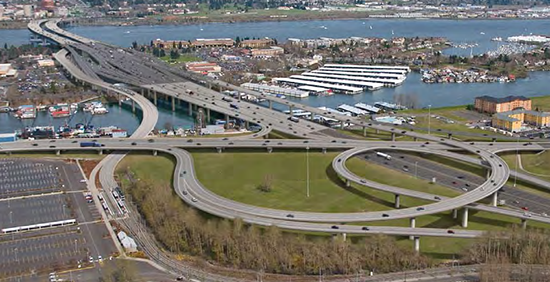
Just as an example, take the proposal for the Columbia River Crossing bridge between Vancouver, Washington and Portland, Oregon. This controversial project would cost at least $3.1 billion (and as much as $10bn) and would provide an average of 1,900 construction jobs per year while being built. Even if costs came in at the low-ball figure of $3.1 billion, that works out to more than $1.6 million per new job, and those are jobs that would only last a few years at most. If the goal is cost-effective job creation then this proposal fails spectacularly.
The obvious point here is that the purpose is not cost-effective job creation. Rather, the value of the bridge itself is what will make this pencil out as a good investment, or not. The cost of the bridge must be weighed against its ability to improve mobility (for both economic and social purposes) and/or increase safety; those measurements, along with the much more speculative and therefore secondary considerations of "added value" or " private investment potential," are the only things that can yield a good return on investment for a product of this nature, or any transportation project for that matter.
The value of 1,900 jobs--or even 10,000--is insignificant relative to the cost of construction, and if keeping those costs low is one of the goals of the project (as it should be), fiscal prudence may work at cross-purposes to maximum employment. And that's okay. Construction jobs may be a nice bonus, but they're only worthy of consideration and celebration after the value of the project itself has been evaluated and maximized. If cost-effective job creation was the goal, we'd be better off paying people $50,000 a year to dig and refill holes all day or pick up garbage off the side of the road.
*The people in question may vary significantly from neighborhood to neighborhood and region to region--this will be dependent on the values of those communities. Some will prioritize the movement of cars and trucks while others will prioritize transit, walking, and/or bicycling. Among these sets of priorities there will certainly be differences in return on investment that should be evaluated critically, but the point is that mobility and safety still must be the primary considerations regardless of who the users of that new or improved infrastructure might be.
New York City is building a lot of bike lanes, and some are complaining that with so few bicycle commuters they're getting more space than they deserve. I look into the numbers and discover that bicyclists are still under-served relative to their share of commuters.
Read MoreI'm attending the Congress for the New Urbanism conference in Salt Lake City this year as part of a Streetsblog Network training/workshop/networking event, and on Wednesday afternoon we had several guest speakers address our group. The last of them was John Norquist, current CNU president and former mayor of Milwaukee, who's urbanist cred as mayor includes the the removal of the Park East Freeway and a decline in poverty coincident with a boom in downtown housing.
Early in his talk he spoke highly of Streetsblog and his own use of the site. He mentioned that, at 63 years old, he doesn't use the computer much, but when he does he regularly drops by Streetsblog to get the news. Clarence, the man responsible for Streetfilms and a big Norquist fan, said that might be the best endorsement Streetsblog has ever received; as such, I thought I'd commemorate the event with a suitable meme.
So without further ado, the Most Interesting Man in the World:
You have to admit, there is a resemblance.
By now everyone's heard of Apple's incredible network of tax shelters, which just in the last several years has saved them tens of billions of dollars in corporate taxes. Pretty much everyone except Rand Paul finds this reprehensible, but while Apple may be the best in the game when it comes to tax avoidance, they're far from the only player. Other big companies like Amazon and Microsoft do the same thing, keeping profits overseas so that they don't have to pay US taxes on them.
In many cases those companies would really like to bring that money back stateside, either to invest in their business here or (more commonly) to pay out dividends or buy back stock from investors. To do that, however, they'd have to pay 35% of those repatriated profits as tax. And no one wants to do that unless they have to.
Fortunately for these mega-corporations, they often don't have to. In 2004, under the Bush administration's leadership, Congress passed a law allowing a tax repatriation holiday, meaning that for a short period of time any profits brought back into the country would not be taxed. The purpose was to ensure that something productive would be done with that money--that it would be reinvested in US jobs and business needs. As the Treasury describes, however, this is not what happened:
In assessing the 2004 tax holiday, the nonpartisan Congressional Research Service reports that most of the largest beneficiaries of the holiday actually cut jobs in 2005-06 – despite overall economy-wide job growth in those years – and many used the repatriated funds simply to repurchase stock or pay dividends. Today, when U.S. corporations have ready access to cash they have accumulated and are holding here in the United States, it is even harder to make the case that a repatriation holiday will unlock new investment and job creation.
And perhaps even worse than all that, now that we have a history of allowing businesses to repatriate their earnings tax-free they have far more incentive to keep their money overseas as long as they can bear, waiting until the next time we forget ourselves and give them another opportunity to cheat the system--and the American public.
On cue, in steps Congressman John Delaney (D-Md.).
His proposed legislation, the Partnership to Build America Act, would create a federal infrastructure bank funded by $50 billion of repatriated corporate profits. Companies would bring their money back to the US, buying infrastructure bank bonds that pay out a low yield over fifty years, and they would pay full taxes on the money repatriated to purchase those bonds. This sounds great because it would take money that's currently sitting overseas doing nothing and use it to fund up to $750 billion in infrastructure projects (via leverage) with a heavy focus on loans and public-private partnerships. It almost sounds too good to be true!
And of course it is, because the catch is that this is much more a repatriation tax holiday than it is an infrastructure fund. Although the ratio sounds somewhat up in the air, Delaney suggests that for every $1 brought back, taxed, and used to purchase bonds, $4 could be repatriated tax free*. In effect, this would reduce the tax burden of repatriated funds by 80%; instead of paying the full 35% corporate tax rate (which is admittedly too high), they would pay a mere 7%. This is exactly what companies like Apple have been waiting for, and would be an utter validation of their tax avoidance strategies.
I obviously care a great deal about funding the infrastructure investment this country needs, and it's difficult to pass up nearly any opportunity to further that cause. But the fact is that if an infrastructure bank is a good idea with repatriated funds then it's also a good deal with taxed or borrowed money. Especially in an era of rapidly falling deficits and near-zero borrowing costs, there's no reason to reward US corporations' dishonesty with a $14 billion windfall just to try to keep the lights on.
Hopefully this proposal will be seen for the stealth repatriation tax holiday that it is and get shut down quickly, and we'll find a more reasonable way to fund the maintenance and mobility investments we require.
*It's hard to be sure if this is exactly how it would work--the description at Transportation Issues Daily, the linked article that describes this proposal is not 100% clear. It might actually allow businesses to buy bonds with money already in the US so that they're actually not paying tax on any repatriated money.
In a recent article posted on New Geography, Aaron M. Renn asks what seems to be a fairly straightforward question: "Why Gentrification?" But unlike most writing on the subject, the question isn't why it happens or how to avoid it, but why cities aspire to it. This is the first sentence of his article:
The mostly commonly chosen means, or at least attempted means, of revitalizing central cities that have fallen on hard times is gentrification.
...What!?
This is perhaps the most egregious misunderstanding of the causes of gentrification that I've ever seen. According to this theory of gentrification, a city--any city, in any of its neighborhoods--could simply tear down a bunch of run-down homes or apartments and replace them with luxury towers, spacious retail and restaurant space, and some nice parks, and suddenly have an influx of affluent residents. It completely ignores the role of demand in driving redevelopment and gentrification, or, at best, gets the causal link between the two exactly backward.
In the real world, gentrification isn't the cause of demand, but the result of it. Cities, or specific neighborhoods within cities, become desirable for one reason or another, and eventually you have an increase in the number of people who are interested in living there. As the ratio of interested people to available housing units increases, competition between potential tenants increases and rents go up as a result. It's not a novel idea; it's exactly the same phenomenon seen in a "seller's market" for home sales, which is pretty noncontroversial.
If gentrification were as simple as providing upscale amenities, places like Detroit could just rebuild their cities and wait for the money to flow in. This never happens in practice, of course, because there's very little demand for living in Detroit.
When the demand does exist, as it does in successful, popular cities throughout the country, city leaders may respond in one of three ways. They can:
Obviously, no one (sane) is going to be in favor of #3. And while many people claim to want to keep things the same, as in #2, the amount of authoritarian city regulation necessary to make such a desire reality would be completely oppressive. It would require that rents be strictly limited, even when old residents moved out willingly and were replaced by new ones, regardless of their income. And besides just forcing new development out somewhere else--probably to a more auto-dependent, less environmentally and economically efficient location--it would discourage building owners from maintaining any of their holdings beyond the bare legal minimum. I encourage you to think through amount and complexity of city control it would take to actually make this work effectively; to do so here would require another post entirely.
The question of gentrification, as most of us know, is not "why do cities pursue it?" but "how do we maximize its positive aspects and prevent or minimize the negative?"
After all, contrary to Renn's assertions, cities don't have much incentive to gentrify. It's a terrible situation for the displaced residents--that isn't in question--but it's bad for cities as well. Displaced residents generally don't end up leaving and bothering some other city, they just end up in lower-quality homes, further away from work, school, and the social or medical services they might depend upon. Whatever those needs might be, they don't disappear just because the family moves a few miles away-- they just become less effective, and more costly to deliver. As even middle-income residents get pushed out of the middle of the city, increased prices push out beyond the city core, affecting everyone negatively. Except landowners, of course.
Reducing displacement is the challenge of gentrification, and thus far, no city has solved it in a completely satisfying way. That's not to say that some haven't been more successful than others though: even San Francisco, notorious for its out-of-this-world rents and home prices, is barely half the cost of Palo Alto ($835k vs $1.55m). At seven times the density, SF has done a much better job of facilitating growth than Palo Alto (although still a comparatively poor job), and this is certainly part of the reason it's not doing as poorly. But San Francisco also only grew by 30,000 people between 1950 and 2010; over that same time period Seattle, a considerably smaller city, increased its population by roughly 140,000. (Just for comparison, Palo Alto has increased in population by only about 10,000 in the past fifty years, although it's much smaller.) What Renn ignores, and what complicates the context of these statistics, is that demand differs between each of these cities, and responses will be, or should be, calibrated accordingly.
Affordable housing, i.e., income-restricted units, are also an option, but can't be successful in isolation. The greater the difference between the average regional rent and the price-controlled affordable housing rent, the greater the burden of subsidization placed on the city and its residents. It's an invaluable resource to those able to secure an affordable unit, but their construction must be accompanied by vigorous market-rate housing development. Otherwise cities end up with unsustainable levels of housing subsidy for little overall benefit, and a system in which only the very rich and very poor lucky enough to find a subsidized unit are able to live there--those in the middle, unable to meet the income-restriction requirements but also unable to afford market-rate rents, are left out in the cold.
I think avoiding bust-and-boom cycles of residential development is also important to limiting the ill effects of gentrification, but I'm going to save that for a later post. I'm certain there are some creative suggestions out there for possible solutions--keeping in mind that no one answer will completely solve the problem of gentrification--and I invite you to share your own ideas here in comments, on Reddit, or with me via email.