Living in the City Isn't Just Cheaper, It's Also a MUCH Better Investment

Image from

The Atlantic

.

More good news on the economics of living in the city

. A recent comparison by David Hughes, a broker at Mortgage Group Ontario, Inc., calculates that, over a 40-year horizon, living in the city costs about the same as it does in the suburbs. Slightly less, in fact.

Specifically, he found that a house in the suburbs valued at $500,000 will cost about $688k over 40 years, and a two-car household will rack up an additional $688k in vehicle costs over that same time-frame. Total cost: $1,304,995.

By comparison, a home in the city valued at $720,000 will cost $1,031,130 over 40 years. A family that doesn't own any personal automobiles but spends about $250 a month on transit and another $250 on taxis and car-share will spend approximately $240k in transportation costs over that time-frame. Total cost: $1,271,130, or about $33,000 less than the suburbs. (Tables for each scenario are found

at the original article

—apparently I don't have permission to recreate them here.)

As the article notes, this doesn't take into account the physical and financial costs associated with the stress of longer commutes, congestion, etc. It also misses something even more important by ignoring what these two hypothetical families are left with at the end of their 40-year experiment: the homes themselves.

The surburban and city houses are both completely paid off, but one is worth far more than the other. When all is said and done, the city-dweller owns a home worth $220,000 more than the suburb-dweller, even though they spent $30,000 less in total housing and transportation costs. This is before taking into account the fact that

urban homes increase in value faster than suburban homes

, and that

homes in the most expensive markets increase in value faster than those in the least expensive markets

. It also ignores the fact that, even given equivalent rates of home appreciation, the gap in value will grow over time. (If both increase in value an average of just 2% per year, the suburban home will be worth $1.1 million in 40 years, and the city home will be worth $1.59 million, almost $500k more.)

While

investing in a home as a primary retirement vehicle may not be the best idea

, if we're talking about spending the same amount of money either way we may as well point out that one option is far superior to the other from an investment standpoint.

As I've written

on multiple occasions, for all the time we spend focused on housing + transportation (H+T) costs, we spend relatively little time discussing its investment implications. Homes are an asset and vehicles are a liability, and in a country where the majority of people aren't saving enough for retirement, it's important that we make this point crystal clear. Yes, living in the suburbs is expensive, unhealthy, unproductive, and bad for the environment. When you earn enough to afford a home, it's also a terrible investment decision.

Bus Seats, LA Edition

There's no point to this post other than to share my favorite transit-oriented meme. That and to highlight how well it describes LA's train and bus seats.

Seats on the Purple Line Metrorail trains in Los Angeles.

Banks Can Play a Major Role in Promoting Smart Growth, If They Want To

I've been limited on time lately so rather than come up with something totally original I'm just gonna riff off of an interesting post I read today.

Over at Streets.MN they're discussing 

the connection between transportation and housing costs

. A well-worn subject to be sure, but the main focus of the post is actually about how banks, not consumers, interpret information about how housing affects transportation costs. And the punchline is that they basically don't interpret it at all; they have all the data they need about where their customers live and work, but choose not to use it when determining mortgage eligibility or lending rates.

This is totally insane, of course, because where you live has a

huge

 impact on your odds of foreclosure, as does where you live relative to where you work and how you get between the two. (If you don't believe me, just type "home foreclosure" in Google Images and see what type of homes come up.) Streetsblog wrote about a study earlier this summer that found

adding ten minutes to average commute time increases the risk of mortgage default by 45%

. Large numbers of people walking or taking rail to work lowers default rates, as does a greater retail presence in a neighborhood, and so on. Banks should obviously care a great deal about this since the balance between "foreclosure" and "not-foreclosure" is how they make their money. And these low-risk communities are exactly the type promoted by organizations like Congress for the New Urbanism and Smart Growth America (and me).

It seems to follow that since walkable, mixed-use communities tend to have lower foreclosure rates, they should also be eligible for lower mortgage interest rates. Fewer people defaulting on their home loans means fewer losses to account for, so the profit that banks need to earn on each individual mortgage can be lower. In turn, those lower rates would increase the appeal of choosing safer, healthier, more sustainable communities in which to live (i.e., walkable urbanism / smart growth).

Advocacy's great—necessary, even—but nothing can make the case for urban living like a sub-3% mortgage interest rate.

Downtown Marquette, Michigan; photo from

Second Wave Media

.

---

A little supplementary information/commentary:

Part of the reason why banks

haven't

figured this out yet is hinted at by the author at Streets.MN: "your small neighborhood bank plans to sell your loan to a larger financial corporation that will either sell it again or make mortgage sausage with it." He's kind of dismissive of this, but it's actually crucially important. It's true that small neighborhood banks are often the ones making the loans for mixed-use buildings and smaller projects, but these banks are by definition capital-constrained. They need to offload those loans to free up capital for additional loans, but if the big banks see the loan as risky or non-standard they may not be as interested in buying them. It's easier to package a thousand cookie-cutter McMansions into a mortgage-backed security than a hundred mixed-use projects of varying heights, masses, retail compositions, neighborhood characters, levels of accessibility, etc.

I admit to being only cursorily knowledgeable about the subject of bank finance so I can't do much to propose a solution, but it seems like there's a place for both government and the private financial industry here. On government's side, the availability of Fannie Mae and Freddie Mac mortgage guarantees needs to be

at least

 as strong for developments in robust walkable areas it is for suburban, single-family home developments (this could either take the form of more support for mixed-use or less for single-family, it doesn't really matter which). Besides the direct benefits, this would also signal to private banks the appeal of this type of housing. On the private side, mostly they just need to be more sophisticated. There are economies associated with standardization, to be sure, but with the amount of talent in the financial industry it seems relatively trivial to develop a standardized means of assessing urban developments for their likely foreclosure risk. From there they just need to assign mortgage rates that reflect the relative safety of these investments and wait for the buyers to flood in.

It's Not Just Crazy Drivers: LA Streets Are Designed For Road Rage

Still shot from

viral video

of a man seriously raging on an LA freeway.

One of my fellow classmates moved to Los Angeles recently, and this was how she summarized her experience thus far: "People here are all so laid back, but as soon as they get in their cars they go insane!" She's from New York, so I'm sure "laid back" is relative, but she's right: people change when they get in their cars here, becoming more aggressive, easily (and visibly) frustrated, and meaner. Highway congestion tends to get the brunt of the blame for this, and that's understandable, given that

it's the worst in the nation

.

Often overlooked, however, are the local and arterial streets in the region, which seem to be designed with the specific intent of frustrating drivers, pedestrians, and bicyclists alike. They often encourage dangerous, aggressive behavior and breed animosity between those in vehicles and those on foot. I've been in LA a month; here's what I've seen so far.

Left-turn signals

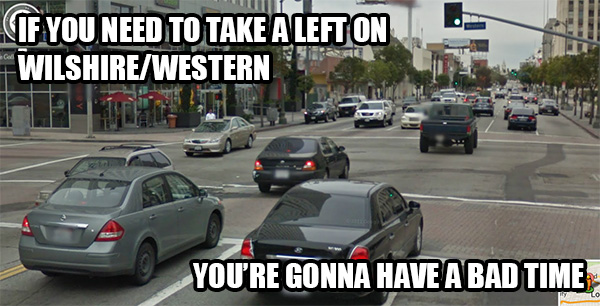
This was by far the most surprising difference between LA and other cities I've been to. In most cities, if left turns are allowed at major intersections they have left-turn arrows that turn green for a few seconds, then they turn red and the forward-traveling traffic is given the green. Here, when you need to take a left turn at an intersection, you are usually given a turn lane, but no light to accompany it. You wait until all the traffic in the opposing lanes clears out, then you go. Or, if it never clears, as is the case at hundreds if not thousands of intersections across the city, you wait until the light turns red and then you go, as do one or two people behind you. If you

don't

 run the red light, expect to be honked at vigorously and angrily, because obeying the traffic signals while making a left turn in LA is

just not done

.

I'm kind of making light of the situation here, but make no mistake, this is an incredible dereliction of duty on the part of city traffic engineers (or whoever is ultimately responsible). Not only does it make drivers needlessly anxious and angry with one another, it's also ridiculously dangerous. The city has given drivers literally no alternative but to blatantly ignore traffic laws, at great peril to themselves, other drivers, and pedestrians. I've already seen several

very

 near misses as a result of this—it's just a matter of time before someone really slips up and gets themselves or someone else killed.

I assume the reason this is so common is throughput: several lanes of traffic can travel at once with a catch-all green light, rather than giving an extra signal turn to a single lane of left-turning drivers. It probably does have some positive effect on traffic. (At least, if you ignore delays caused by collisions with other cars or people.) But—and I really shouldn't even have to say this—encouraging people to illegally drive through several lanes of green-lighted cross-traffic

and

a crosswalk that people may have already started moving through is

not

 the way to improve traffic flow.

Push-button crosswalk signals, aka beg buttons

People may not give much thought to these since they show up all over the city, even very pedestrian-heavy areas like downtown and Koreatown. If you don't walk often, or don't really think very hard about how these buttons work, as a pedestrian you might think these buttons are in place for your benefit. In truth, they exist to optimize vehicle travel, not that of pedestrians. (Gary Kavanagh at Streetsblog LA has

a good recent writeup on the subject

.)

In cities with good walking infrastructure it's taken for granted that there will be pedestrians waiting to cross the street, so they're automatically given a turn when traffic moving in the parallel direction is given the green light. This does have an impact on traffic. Since pedestrians cross the intersection slower than cars, the green light for cars may often stay green longer than it takes for all the cars to get through. This slows things down for cars waiting in the perpendicular directions, but it gives pedestrians sufficient time and safety to cross the street.

By comparison, at many intersections in Los Angeles there are buttons you must hit if you want to be given the walk signal. If you don't manage to hit it before the parallel traffic gets a green light, you're out of luck. The green light will be shorter for cars, and you're instructed to wait for a whole new light cycle. The thing is, there's no functional difference in the way traffic is moving through the intersection when you don't get to the button in time—the difference is that you have less time to cross, cars see you have a red "don't walk" signal at the crosswalk, and they don't necessarily expect you to walk. I and many others still do because it's completely safe, so long as we're aware of what the cars around us are doing and we're across by the time the cross-direction traffic is given the green. But drivers who see a pedestrian walking against a stop signal may get angry that they're being blocked from turning since they're unlikely to understand how the signal works. Combine this with a busy intersection with no left-turn arrow for cars and you've got a recipe for road rage. And that's to say nothing of how unnecessarily dangerous this can be.

As a side note, getting rid of all of these crosswalk buttons would also be cheaper in the long run, as no more would need to be installed, nor would they need to be maintained any longer. And when they

do

 break, what are pedestrians to do? In those cases they're left with no safe means of crossing the road.

Right turns on red

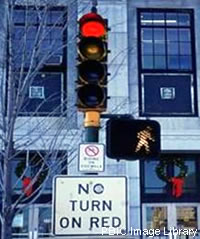
This is by no means unique to LA, but in tandem with other street design problems in the city, right turns on red just add to the madness. They don't belong in big cities, LA or otherwise.

If you're waiting in your car at a red light in Los Angeles you can take a free right as long as the crosswalk and the lane you're turning into are clear. This causes a huge amount of collisions with other drivers and with pedestrians, which is problem enough, but it also causes endless annoyance and frustration to drivers in pedestrian-heavy areas.

The reason is that rather than just wait 20 seconds, drivers are encouraged to try to inch through the intersection when a gap in pedestrian traffic shows up, but anyone who's tried to navigate this delicate maneuver is familiar with the heart-in-your-throat feeling you get when someone seems to jump out of nowhere and you have to stop abruptly (or when someone just

needs to hurry the hell up and get through the crosswalk)

. Now there's a pedestrian angry with you—and rightly so, since they probably feel like you could have seriously injured them—or you're angry at the inconsiderate ped, or both.

It may sound counter-intuitive that limiting the rights of drivers would make them better off, but in this case some paternalism is warranted. The time savings you get from threading the needle through a group of pedestrians is meager, of course. More generally, this fits with a street design ethos that seems to expect professional-level driving skill from the entire population—as does the lack of left-turn signals at intersections. If the

90% of drivers who think they're above average

were actually correct, this might be okay, but in the real world building your roads so that only the most skilled can use them safely is a recipe for disaster. (As a side note, this might also discourage people from "cruising" in high-traffic areas looking for parking—

estimated to be responsible for as much as 74% of downtown traffic

—since the penalty for constantly circling around the block taking right turns would be much higher if you had to wait at every light.)

In either case this just adds to the stress of driving. If you've tried driving in an area like downtown you've almost certainly been yelled at by a pedestrian; it was probably as you blocked the crosswalk and they flipped you off and walked around your car. It wasn't intentional, and you felt appropriately contrite, but I can almost guarantee you ended up in that position while trying to take a free right turn. Once again, the city's design pitted you against the pedestrian and the results were predictable.

These are mostly easy fixes in the grand scheme of things, both in technical difficulty and expense. Maybe some of the congestion savings yielded from the

massive traffic light synchronization effort

can be used to improve safety and reduce the tension and stress of commuting.

I'm still a new resident to Los Angeles and sure to have missed some things. What other street design problems have you seen here, or in other cities? Have you seen any particularly innovative solutions?

What Do Solar Power, Affirmative Action, and Urban Planning Have in Common?

A clean slate isn't enough for housing and transportation policy.

A Bronx development with rooftop gardens shaded by solar panels, photo from

Bloomberg

.

Debating the merits of more sustainable forms of energy, some people claim to be supportive in theory but disagree with the idea of government intervening to pick winners and losers. "Let solar, wind, nuclear, coal, and oil duke it out in the free market, and may the best man win," they say.

Opposition to affirmative action relies on a similar strain of thought—i.e., government, stay out of it. Blacks and other historically disadvantaged minorities have all the same legal rights as whites now, so we shouldn't let race play a role in our hiring practices. The days of explicit employment discrimination based on race and/or ethnicity are behind us, so our goal should be a purely merit-based system.

These arguments may sound reasonable and even-handed, but they share an (often) willful ignorance of the enduring power of institutions, and the role past policies played in constructing them.

In the case of solar power and other forms of renewable energy, there is no

tabula rasa

for competition with coal and oil. Oil extraction and production has been

subsidized by the U.S. government for nearly 100 years

, and the industry has been able to build an incredible portfolio of land rights, capital goods, and political and human resources. Even if the government immediately withdrew the

up to $50 billion a year

 it spends in support of oil extraction, production, and shipment, the physical and logistical resources amassed over the past century would remain. Demanding that relatively new sustainable energy industries compete on equal footing with an oil industry established over generations, and with trillions of dollars of taxpayer money, is both unrealistic and dishonest.

Huntington Beach oil field/beach in 1928, photo from the

Washington Post

.

Affirmative action is a more controversial issue, and one which reasonable people will disagree about, but the argument in support of it is similar. It starts with the idea that there's more to finding and securing a good job than the qualifications you can put on a resume. Everyone seems to be aware that connections are important—"it's not what you know, it's who you know!"—and the reality is that, largely due to the systematic racism of previous generations, disadvantaged minorities tend not to know the kind of people that can put in a good word for them, get them a foot in the door, etc. A black man who was qualified to go to school for engineering in the 1950s might instead have been forced to take a job as a janitor, and his children would grow up with less money and fewer connections to people in more prestigious, higher-paying positions. When they reach adulthood they're unlikely to have the same "ins" as those who grew up in more socioeconomically advantaged families.

And so it is with urban planning and development.

When I wrote last week that

some Millennials will move back to the suburbs and that's okay

, one criticism I received was that (paraphrasing) "No, actually it's not okay. Suburbs are economically and ecologically unsustainable, and there's nothing good about more people living in them."

My response was that it's not our goal to decide where people should live, and that we should focus our efforts on eliminating the

various subsidies that make suburban sprawl artificially cheap

. Without those subsidies, people are free to make whatever decision they like as to where they live, but with full awareness and responsibility for the costs of that choice.

But that's not the whole story. As with sustainable energy and affirmative action, history matters. Removing the current incentives for building and living in sprawl-type housing does nothing to change the character of previous developments; freeways built through city centers for the benefit of suburban commuters aren't going anywhere (

mostly

); and lenders will continue to be most comfortable with single-family, greenfield-type development after many decades of being conditioned to it. Even the pop culture appeal of "the house with a white picket fence" will likely persist, despite

a massive shift in the desirability of smaller, mixed-income, transit-accessible housing

.

No money for repairs, or for lacrosse gear. :(

In other words, suburbs are like the kid with the rich parents—or the rich Uncle Sam, as the case may be. You know, the ones that sent him to the best schools and prep courses, paid his way through college, got him his first internship, and paid his rent until he got on his feet at his first real job. Cities are the janitor's kid who was begrudged by wealthy families for being on the reduced-price lunch program, even as they spent thousands of dollars affording their child every possible advantage. Just because your parents cut you off when you turned 25 doesn't mean you're now on equal footing with the janitor's son.

Cities have been abused and neglected by the policies of our federal government over the past sixty-plus years, and they've overcome a great many challenges to finally begin truly thriving. Whether you live downtown or in the most rural exurb, you should be encouraged by that. But despite the recent success of cities, we can't ignore the fact that they're not working for lots of people. Exactly because of their incredible success they've become unaffordable to many lower-income households. As the great suburban experiment unravels, the demand for smaller, closer-to-work housing is only going to grow, and the pressure on low income families is going to grow with it. To capture that growth in cities without placing further burdens on the most vulnerable will be difficult.

To do so, the response needs to go beyond ending the wasteful subsidies for new suburban development. We need a rebalancing, one with much greater support for existing communities, both for urban neighborhoods and suburbs that commit to more economically and ecologically sustainable infill development. Simply wiping the slate clean of subsidies entirely does little to solve the growing affordability crisis for low- and middle-income families, and will result in more displacement than new urban housing. Unlike with sprawl, there are

numerous reasons

to make it easier for people to live less car-dependent lives (or at least encourage shorter commutes), so this should be a no-brainer. The same goes for our overbuilt network of urban highways and

stroads

. Communities affected need support, not indifference. The Federal Highway Administration took a tire iron to the kneecap of cities it built these highways through—promising not to build anymore isn't enough when the neighborhoods surrounding them now walk with a permanent limp.

On the bright side, there are plenty of underpasses

for all the newly homeless people to sleep under.

We can help cities and their residents adapt to their growing populations by taking 

the money we're using to pay wealthy families to buy homes

and using it to boost our affordable housing programs,

Section 8

, and

Community Development Block Grants

,

rather than cutting them

. This can be done in both cities and suburbs. With that money alone, we could quadruple the budgets of both programs. The money we spend on the suburbs should be used to make them

more resilient and productive

, not just bigger. Five-mile bike rides and one-mile walks should be treated as at least as valuable as car trips and our federal expenditures should reflect that, instead of representing the 

less than 2% of transportation spending

they do today. Federal transit spending should do more than keep the lights on; it should build for the future, as highway spending did sixty years ago.

The suburbs have been and continue to be coddled with incredibly expensive road projects and tract developments, neither of which pencil out economically without federal and state support. All the while, cities have mostly been forced to go it alone, and even the major highway projects within their borders have been in service to suburban commuters and those just passing through. It's time for us to invest some money in the people who choose lives of sustainability, greater economic efficiency and productivity, and more consistent physical activity, and to stop spending it on the opposite.

Home Values in the New Millenium: The Rich Get Richer

House prices in the most expensive large markets increased four times faster than homes in the least expensive markets

A few weeks ago I linked to an interesting article by Matt Yglesias where he made the smart point that while some may benefit from increased home prices, they don't do much good for society as a whole. If your home increases in value faster than the national average, you're better off, sure, but by definition this only applies to half of homeowners. For the other half, their homes increase in value at a rate slower than the national average. Some win and some lose, but on average higher prices just mean we're spending more money on housing and less on the other things we might want to buy or invest in.

And as it turns out, the lucky half—those whose homes appreciate faster than average—aren't exactly representative of the entire population of homeowners. Like so many other aspects of the modern economy, the greatest benefits of homeownership appear to be accruing to our most affluent citizens while the rest of us fight over the scraps.

In the below graph, I've averaged the home price indices over the past 13 years for the six most-expensive housing markets* in the Case-Shiller Composite 20 index, as well as for the six least-expensive markets** (excluding Detroit and Las Vegas, because that just wouldn't be fair). The year 2000 is the index point, so the graphs represent the percentage increase in value from that year—a y-axis value of 160 would represent a 60 percent increase in value since the year 2000:

Since 2000, homes in the most expensive markets increased in value by about 80 percent on average, while home prices in the cheapest markets went up by only 20 percent. And no, the increase over the last thirteen years isn't responsible for the difference in current home values: the average value of homes in the expensive markets was $363,902 in 2000, while the average home in the more affordable markets was just $171,612.† If you could afford to buy a $360,000 home in 2000 you've probably done quite well; if you were only able to afford a down-market home, not so much. It takes money to make money, I guess.

We're spending hundreds of billions of dollars a year promoting homeownership, and just as with the mortgage interest tax deduction, the vast majority of the benefit is going to the upper and upper-middle class—those that can afford a home worth $500,000 or more. People in the working- and middle-class are being incentivized to buy (and even penalized for renting), but the homes they can actually afford to purchase aren't the ones that are creating significant wealth. If our primary goal in federal housing policy is really to create "Security for the Middle Class," we've still got a long way to go.


  1. *San Francisco, Los Angeles, San Diego, New York, Washington, D.C., and Boston. 
  2. **Chicago, Charlotte, Dallas, Atlanta, Tampa, and Cleveland. 
  3. †Data from the Lincoln Institute of Land Policy

Real life update: off duty this week

For those of you who read my posts here regularly, you may have noticed that the content has been really light the last week or so. I've been packing all my stuff up in Seattle and am now on my way down to LA on a road trip with some friends.

We're in San Francisco now, and I'll be busy with them in LA through the week, then probably quite busy with getting settled into school and (hopefully) meeting many of the people I've made plans with, so I probably won't be quite as on top of the blog as I'd like for the next few weeks. Once things have fallen back into a little more of a routine I should be back to posting regularly.

And hey, if you're in LA and would like to meet to talk transportation, urban planning, whatever, send an email my way and let's set something up! I'm looking forward to getting to know the area and its sustainable transportation advocates!