| From Transportation For America. |
As economic stimulus, the USPS is an incredible deal
Photo by Graeme Pow.
I haven't written about it on here before, but I've had pretty harsh things to say about the USPS over the past few years. As someone who frequently extols the virtues of urbanism and is bothered by the outsize subsidies associated with rural life, it irks me that I pay the same to ship a letter as someone who lives 50 miles from the nearest post office. Perhaps more importantly, I'm just not convinced that first class mail delivery is a strictly necessary government service in the year 2013. This was all no big deal as long as they were profitable, but now they're losing billions a year.
The Postal Service is on track to lose about $10 billion this year. And to be fair, a big part of the reason for that is a Congressional mandate, unique to the USPS, that they pay their future retirees' health benefits out to 75 years in the future. They tried to save a few billion dollars a year by cutting Saturday service, but that was quickly squashed by yet another Congressional mandate, this time requiring that they maintain six-days-a-week service.
But in a time of continuing high unemployment, maybe we need to look at this from another perspective. To get that perspective, let's look back a few years. As the job losses caused by the financial crash of 2008 were peaking, we passed a $787 billion stimulus package to save and create as many jobs as possible, and according to the CBO it was somewhat successful: as many as 3.3 million jobs were saved. Taking that number as a given, this means that each job cost at least $238,000. This was spread over three years, and for various reasons its misleading to say each job actually cost that much, but we'll just accept it for now.
By contrast, the USPS employs about 522,000 people (though that number is declining rapidly) who earn an average of about $50,000 a year and get some pretty nice federal benefits. Good middle class jobs, in other words. If the Postal Service loses $10 billion this year and keeps all of their employees, it'll cost taxpayers about $19,000 per job saved. If we got that kind of return on the 2009 stimulus we could have put every unemployed and underemployed person in America back to work, and then some.
How many federal workers do you know whose wages are mostly covered by user fees? Photo by komunews.
Now, part of the point of the stimulus was to keep people employed long enough for the economy to get back on its feet, not to subsidize those jobs year after year into infinity (which is part of why the $228k per job number is misleading). To get to that level of spending, though, we'd have to subsidize the USPS at its current loss levels for over 10 years. At a time where unemployment is still over 7%, is deficit reduction still such an imperative that we can't afford to keep the Postal Service afloat as it reorients itself over the next several years? Can we really hope for such a good employment deal in any other spending package?
Some people might argue that the USPS isn't like other federal organizations--they're a business, not a public service organization or entitlement like Medicare, so its not the taxpayer's responsibility to shore them up when they get in trouble. But if they were really a business, could the US Congress mandate that they, and they alone, spend billions of dollars on costs that won't be incurred for another three quarters of a century? If it wasn't a public service, could Congress force them to provide their services six days a week, no fewer?
Maybe I'm overlooking something obvious, but I don't see how our lives would be significantly worse as a result of dropping to five-, or even three-day-a-week first class mail service (letter-type mail, not larger packages). We're forcing them to deliver every day because we find it convenient, that's all. We have the power to override the business decisions of the Postal Service for the sake of our convenience and we exercise that power, so as long as we retain that power the responsibility flows both ways. They have to do as we say, but when that gets them in trouble it's on us to bail them out.
I'm not proposing that we preserve employment into perpetuity--it's pretty clear that the USPS is on its way out eventually, or at best will be a much, much smaller organization in the not-too-distant future. In particular, I think we should be discussing whether six-day service is necessary anywhere, and especially where it's most expensive to provide. But anyone who's experiencing any kind of righteous indignation about Postal Service financial losses needs to look first to their Congresspersons, and themselves. Then they need to look at the unemployment number and think about whether this is really the best time to be laying off more people from well-paying, useful work. Even if its not strictly necessary.
Private transportation: no operations subsidy, but at what cost?
Northwest Airlines, now owned by Delta, from Cliff1066.
On this blog I've tried to draw attention to the expectations and perceptions we have of different forms of transportation, and in particular the lack of scrutiny that airline subsidies get relative to that of train services. They each receive billions of local and federal dollars for infrastructure and for operations (TSA and air traffic control for air, basically all rail employees); airlines are privately owned though, and passenger rail is not, so it gets more negative press when it loses money. But while we may spend less on per-mile subsidies for air travel, we're finding more and more that private transportation has its own costs: steadily decreasing quality in the form of higher fares and more fees, less comfort, and fewer options.
A recent Brookings report highlights Delta Airlines' recent elimination of hub services in Memphis as emblematic of the trend toward consolidation of both airport hub designations and airlines themselves: customers are being left with fewer departure options, their airline choices are increasingly limited, and the flights they do manage to get are nearer full-capacity. Shortly thereafter, another article, by David King and David Levinson at Streets.MN, thoroughly explored the benefits and drawbacks of private networks, like broadband services, and public ones, like the US interstate system.
I include a summary of both because this quote from the latter article unwittingly explains the problems discussed in the Brookings report (emphasis mine):
Generally speaking, the public will over-invest in network size relative to the social optimum and the private sector will under-invest relative to optimum, though it gets very complicated.
Much like the US highway system, we can think of the various connections between airports and hubs as a network, and it's clear that the private airline sector, as it retrenches, is under-investing relative to the social optimum. The purpose of private businesses is not to strive for the social optimum, of course. Its purpose is to make a profit. This is why you see more and more fees, fewer flights with center seats unoccupied, and more concentrated hub services. The airline industry needs to make a profit to continue to exist, and its had a pretty rough time of it over the years:
In virtually every way--cost, convenience, comfort--air travel has gotten worse over the past decade, even without consideration for the burdensome security regulations imposed upon them in the wake of the September 11th terrorist attacks. But without those changes, without the baggage fees, the full planes, the discontinued routes, airlines simply couldn't afford to operate. It couldn't be any other way than this. Airlines had over-invested in their network, and now we're seeing them pull back. We as taxpayers haven't had to absorb the financial losses of the past decade, but we've paid in poorer quality of service by nearly every metric.
Whether that's a fair price to pay is up for debate. For my part, I feel no particular urge to change it, and it would probably be an insurmountable task even if it were desirable. This is the new normal. Next time you're unhappy with the quality of your flight, it might help to remember that back when flights were more enjoyable the airline was probably losing money on it.
As I've stated in previous posts, I'm not interested in bashing on airlines. I think they're fine, for what they're here to do. What I'm mostly interested in is a recognition of the fantasy-land of aviation we've been living in, where for the past 30 years the industry's average profit margins have been just 1%. We've been flying around at basically zero markup--private businesses don't like that. As the profit margins of North American airlines increase over the next few years (they're around 4% now), we're likely to get a more realistic view of what real private transportation networks look like, and then we can look at things like propositions for privatization of Amtrak's Northeast Corridor from a much more informed, realistic perspective.
News Roundup: June 19, 2013
| Feed me your cars! Photo by Alan Durning. |
News Roundup: June 17, 2013
Do remote state capitals produce less effective governments?
Last month, the Atlantic Cities reported on a very interesting study by Harvard researchers linking the distance of state capitals from major population centers to corruption. Generally speaking, the more remote the capital, the more corruption there was in that state (as measured by federal convictions). As ever, correlation is not causation and there are plenty of outliers, but the findings are intriguing nonetheless.
They also got me to thinking: beyond its potential role in facilitating the occasional corrupt act by an individual or small group of individuals, could the isolation of state capitals have an impact on the average quality of all bureaucratic talent? Corruption is obviously a big deal, but usually limited in scope; a systemic under-recruitment of talented, ambitious public employees at the state level could have far more devastating effects in the long term.
To see why our remote capitals might be doing a disservice to good governance, we don't even need to look at government employment. To some extent, publicly- and privately-owned businesses are already responding to the heightened attraction of the "major population centers" those Harvard researchers were referring to: Twitter decided to locate in San Francisco, Google put offices in New York City, Amazon is rapidly expanding operations in the core of Seattle. These are expensive markets, and superficially it might seem like a waste of money, but these major corporations have reached the conclusion that they need to be located in dense, walkable, transit-rich cities if they want to attract the talent they need to continue to be successful. Why should it be any different for state employees?
Of course, there are plenty of highly qualified and capable people that actually prefer to live in the smaller-city/suburban atmosphere. That's fine. In cities like Albany or Olympia or Sacramento, though, you're significantly limited in the type of lifestyle you can lead. It's basically suburban car-dependence or bust. And while there are many millions of people who want exactly that, there are as many or more who don't want anything like it, or at least wouldn't rank it highly if they had complete freedom of choice.
Austin's urban capital building in the background. (source)
Large cities, on the other hand, can provide a place for a much larger group of people with a much broader set of interests. The woman who wants to live downtown and spend her leisure time in coffee shops and bars, and seeing live music and poetry readings is free to do so; the man who wants to spend most of his time in his room blogging and reading (ahem) but values the convenience of a grocery store down the road and work within bicycling distance can get what he wants; those that do want the two-car garage, front and back yards, and relative seclusion of the suburbs can always find it without venturing too far. If you can capture a wider swathe of the population (both demographically and in absolute number) in your commute-shed (if that's a word) then you can pick from a larger pool of applicants for your Auditor's office, Liquor Control Board, Department of Health, and on and on. Some of those applicants wouldn't have been interested if the job had been in a remote town, and some of those will be extremely good at their jobs.
The method by which you might study this question is something I'd be interested in hearing from readers about. How do you measure the impact of a more effective workforce? Per-capita income or population-adjusted GDP seems like an obvious choice, but it's likely that if the distance of capitals has any impact it's on the order of a few percentage points of growth and could easily be swamped by other internal or external factors (like a giant recession, for example). And what's the control group? There are also definitely potential benefits like better institutional design that improves responsiveness to constituent concerns or higher quality web sites (read: http://www.altcew.org/), neither of which would necessarily show up in the state's economy but would improve people's lives nonetheless.
One additional note: I just want to make it clear that I'm not saying our current public officials are underqualified or generally doing a poor job--this isn't a critique on existing bureaucratic efficiency or effectiveness at all. In the spirit of this blog's name, it's simply a recognition that things can always be better, and we should be open to considering anything that might fulfill that mission.
News Roundup: June 14, 2013
News Roundup: June 12, 2013
34th and Stone: the Burke-Gilman's most dangerous intersection?
The Burke-Gilman trail is an incredible transportation and recreational resource for the city of Seattle. Not only do I (along with hundreds if not thousands of others) use it nearly every day for commuting to work from Ballard, I also credit it with getting me back into riding my bicycle several years ago. Jumping straight into riding the streets of Seattle was daunting after growing up in the suburbs and not getting on a bike since my sixteenth birthday; the Burke-Gilman offered me a safe, comfortable place to regain my skills and ultimately opened up the rest of the city to me and my bike.
With special concern for newer riders, and those who are just new to the Burke-Gilman, I have to draw attention to the very unsafe conditions in Fremont at North 34th St and Stone Way. Anyone who's biked through here is probably familiar with the problem. I was motivated to write this post after seeing a bicyclist come within a few inches of being hit by a taxi today, and while I'm tempted to blame the generally manic and dangerous driving of cab drivers here, the fact is that neither the driver nor the bicyclist really did anything egregiously wrong. To see why, we need to look at the intersection.
First, here's the view headed westbound on the Burke Gilman:
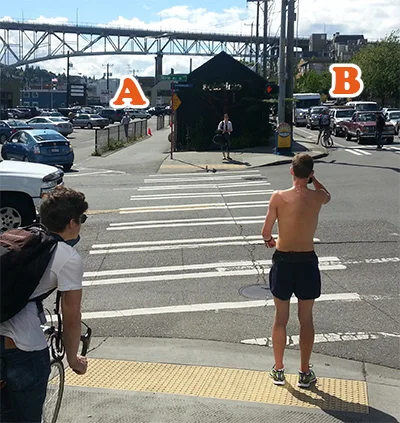
I've marked the lanes in question with letters: the space below the "A" between the fence and the dark building is the Burke-Gilman trail, and the space below the "B" is the eastbound car lane. What you can probably gather from this image is that the people going eastbound on the Burke-Gilman (i.e., toward me, traveling down the "A" lane) can't see what's going on in the "B" lane as they approach the crosswalk.
The following image illustrates the scale of this blind spot even better:
For more than 100 feet the bicyclist is unable to see what's going on in the car lane, and vice versa. The problem is actually worse than that, since the car lane is at a higher elevation than the trail up until the building blocks the view, so neither drivers nor bicyclists have any idea what to expect until they get to the crosswalk. And as I highlighted in the above image, the bicyclist is sometimes being told during the length of this blind spot that he or she is cleared to ride through the crosswalk.
Here's what it looks like from the eastbound car lane, at the stop line on 34th St. at Stone Way:
The reason this is a problem, of course, is that crosswalk signals tend to say "walk" when the parallel vehicle lanes's traffic lights are green, so cars can and do take right turns through the crosswalk while bicyclists and pedestrians are using it. And although I'm sure it's technically illegal for a car to take a right turn through a crosswalk without taking due care to look for pedestrians and bicyclists, in practice this isn't done very easily; drivers really can't see who might be coming up from behind that Solsticio building without already starting to encroach on the crosswalk. I'm certainly not trying to defend their actions, but this is at least partially the fault of the road design making it very difficult to see potential hazards (i.e., people).
On the flip side, some of the blame goes to bicyclists who don't slow down enough while moving through the crosswalk. (I'm guilty of this.) Even with a walk signal it's a very risky move to roll through a crosswalk at 15 mph or more when cars just a few feet away have a green light to pass through the crosswalk. We can get indignant about the fact that we have the greater right to the space, and we probably should, but that doesn't change the fact that if there's a collision we're the ones getting hurt.
Currently, the crosswalk signal only says "walk" for a portion of the time that the parallel car lanes are green, so in theory bikes and pedestrians get their chance to get through then cars get theirs. In reality this is a very busy, often backed-up road for cars, and if they see what looks like a clear crosswalk during the walk signal period they're usually going to go for it. If it hasn't happened already (and I'd be very surprised if that were the case), it's just a matter of time before someone is hit and possibly seriously injured. And it's especially likely to be a bicyclist who doesn't know to be wary of cars they can't see until the last minute. Something needs to be done.
What should it be? I'm not sure. Because of the amount of traffic on 34th St during rush hours and the lack of a right-turn-only lane it seems unlikely that we'll see any kind of partial limitations on right turns--if they were prevented until the crosswalk signal said "stop" you'd end up with the one driver waiting to turn blocking dozens of cars behind him for half the duration of the green light. I don't honestly care what the solution is as long as it works, but the first idea that comes to mind is to eliminate all right turns from the eastbound lane of 34th St.:
Alternate route for 34th St drivers, along N Northlake Pl.
At worst this would divert drivers a few blocks, and, based on my own anecdotal experience, many of them are headed east of Gas Works park (which starts at the bottom right of the above map) anyway. A possible compromise could be engineered in which drivers can take a right at Stone Way during the car-only phase but must travel through otherwise, but that might be overly complex.
Regardless of the solution, the city needs to take a look at this and start work on a solution. If the several near-misses I've seen in the past few months are any indication, the status quo is a serious accident waiting to happen.
News Roundup: June 10, 2013
How To Calm The Urban Parking Wars (Slate)
Report: the FRA makes trains less safe, more expensive (Vibrant Bay Area)